“The world is a book and those who do not travel read only one page.” – St. Augustine

Saturday, May 25, 2019

Vainu Bappu Observatory

Long ago, I had read a book How I killed Pluto And Why It Had It Coming. This book explains how the author uses a telescope to discover exoplanets and how he used programming to achieve it. This book inspired me to learn skills in other field other than computer science. Taking up skills from multiple areas can help in brining unique ideas.


Later, I have read couple of physics books from Stephen Hawking and Richard Fenyman and as a curious person I am I wanted to learn more. I discovered this telescope close to Bangalore. Vainu Bappu Observatory. Did some research and found that the observatory has multiple big telescopes and a small 8 inch telescope. The 8 inch telescope is available for public on Saturday evenings.

So I visited the observatory this Saturday evening. The drive from Bangalore was calm and we had good roads almost till the observatory. The night sky is very amazing here because of the very less light pollution here.

The first time I enjoyed the night sky is when I was so young and we had gone to the nearby village for a family function. Once the function was done, we were supposed to walk to our village with our whole extended family. The elders waited for the night to grow on us so that we get more moon light to make our path so visible. We walked back to our village in night with no mobiles and very few torches. That was the first time I realized how bright the moonlight is. The next time also it was almost a similar incident. Coming back from a wedding night in a load auto. I had this feeling how beautiful the sky is. This time I did have a mobile phone with a camera. I tried clicking a photo of the night sky and realized not all things beautiful can be captured on a camera.

The next time was when I was in Rameshwaram. We had stayed in a small property which was shared by us and a couple from US. They had showed us the Sky Map mobile app and helped us identify objects on the sky. We clicked couple of awesome pics of the night sky with help from them.

After this it was a long time since I had enjoyed night sky. The next time was while camping in Gandikota and the next was this night at the observatory. Even though the place was bit crowded and the telescope was very small, we had some good time there.

En route to the observatory


Thursday, April 18, 2019

Shravanabelagola

This small village is a jain pilgrim place located between the two rocky hills Vindhyagiri and Chandragiri in Hassan district of Karnataka. It is an important jain pilgrimage and religious centre in South India. The hill is filled with a lot of inscriptions. The authorities have tried to protect the inscriptions in the surface by placing glasses around the inscriptions and providing a translation of the inscription. But they have started to break and needs repair.

Vindhyagiri - Gommateshwara: Shravanabelagola known as Gommatapura & Dakshina Kashi in inscriptions picturesquely set in between the two rocky hills Vindhyagiri and Chandragiri (locally called as Doddabetta and Chikkabetta respectively), derives its name from the splendid tank in the middle of the town referred to as the Velagola or Dhavala Sarovara is an important holy place for the Jains even today.

What attracted me to this place is the colossal statue of Bhagavan Bahubali Gommateshwara. This standing statue is the tallest monolithic stone sculpture in the world. And all this is surrounded by swaying coconut trees and natural water bodies. The view is amazing once you are at the top of the hill. One can observe the other hill from here and the green water tank between them.

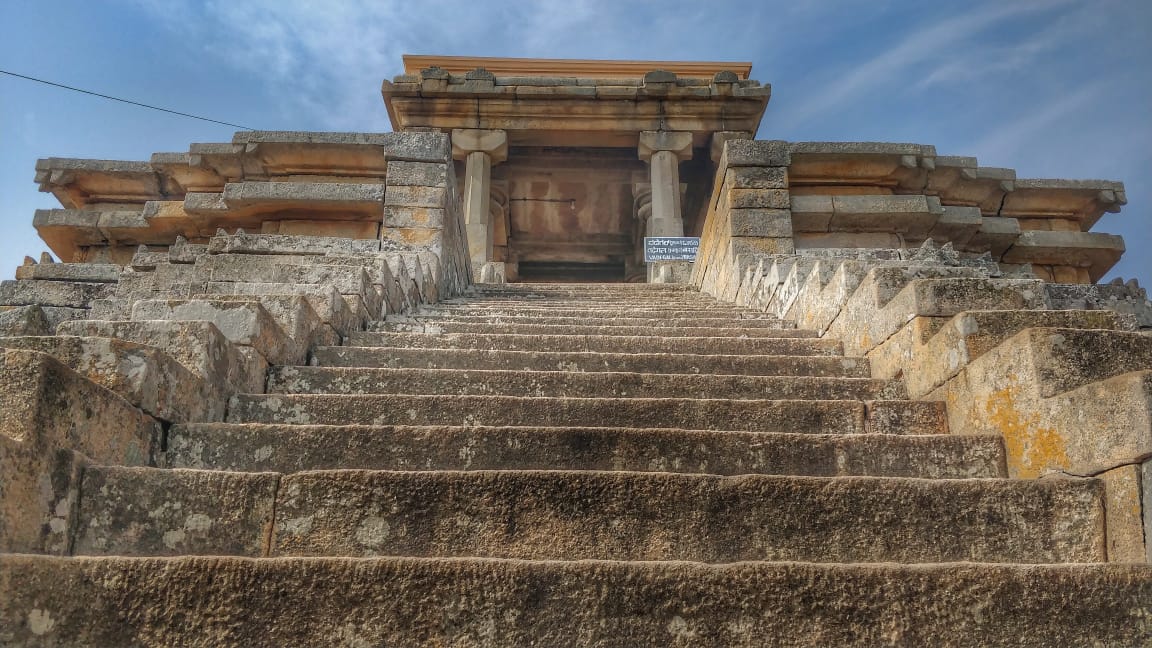
We first visited Vindhyagiri, the hill which hosts the colossal Bahubali. The climb is steep with guard rails and has around 600 steps. You are not allowed to wear your shoes when you climb. And as the surface gets hotter as the sun rises its difficult to walk. One can buy socks for twenty rupees at the foothill. The beginning of the steps is started with a simple arch.


Archway

Sri Parshwanatha jaruguppe temple is found towards your left at the very beginning of the ascend. Next as we climb up one can find a small gopura above the mid doorway. On both sides of this doorway, there is a big wall constructed out of stone blocks.

View of Chandragiri from Vindhyagiri
After you enter the compound the first structure you notice is the Odegallu Basadi. This structure is built on an elevated stone platform. Might be it was done to built the structure on a plain surface. There are three sanctums sanctorum in this temple. In this temple we find seated statues of Adinatha tirthankara, Shantinatha tirthankara and the Neminatha tirthankara. We felt that it should have been a difficult task to carve statues without dress and differentiate each person from the other. We were still able to feel the difference with broad shoulders and a flat tummy. The platform which supports this structure is supported by slanted stone pillars to keep the whole structure in place.

Odegal Basti: The Odegal Basti is so called because of the stone props against its basement. It is the only triple shrine temple at Shravanabelagola. Built of granite blocks, it is impressive for the commanding position it occupies. All the pillars in the main hall are circular in shape and the outer walls are very simple. In the three sanctums are beautiful images of Thirthankaras carved in schist. The temple is datable to 14th century AD. In literary works the temple is known as Tirkuta Basadi.

Odegallu Basadi

Odegallu Basadi

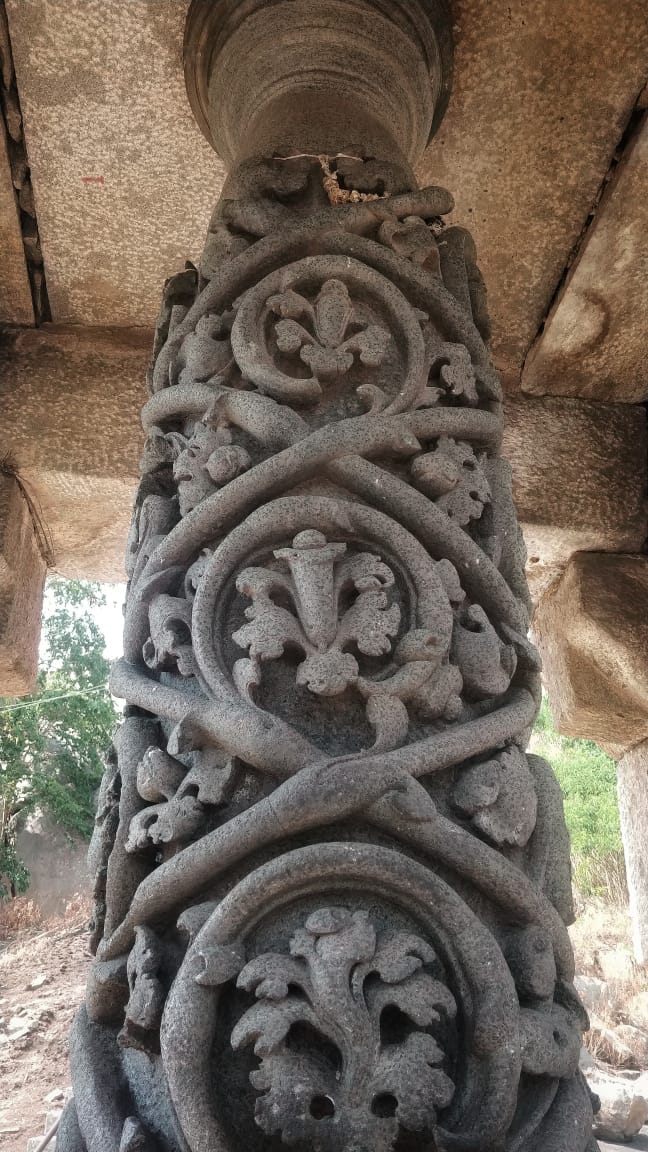
Next on the path to the top is the Tyagada Kambha. This is a small structure supported by four pillars and a small mandapa built with stone and mortar at the top. This structure houses a beautifully carved cylindrical pillar with great workmanship.

Tyagada Kamba: This small, open, pavillion, with an upper storey is historically important. In the center of the pavilion is an elaborately carved pillar which is unmatched in artistic beauty. It was probably erected in the late 10th century. It is believed that minister Chavundaraya distributed gifts to the needy and the deserving from here. Another view is that he renounced from here all his worldly possessions including his life. the simple scroll designs, elegant workmanship, and bold lines, bring out the best of the Ganga workmanship. The original inscription at the base of was erected in about 1200 AD by Heggade Kanna. This Heggade installed the Yaksha image on top of this pillar, and got a record engraved at its pedestal. Some 500 years later, an upper mantapa was built in brick and mortar.


Next enroute is the Gajalaxmi doorway. The image of goddess Gajalakshmi seated on a lotus is found above the lintel of the doorway. On both sides of this Lakshmi idol, we find the carvings of elephants holdings a pot in their trunk, which appears as though the elephants are sprinkling the sacred water on goddess Lakshmi. On either sides of the elephants we find enchanting carvings of Makara the mythical animals and the Lions.

There is big boulder to the left side of the doorway with delicate carvings of jain saints and an inscription. There are two more doorways with beautiful pillars and carvings. After you climb this couple of steps you reach the last compound of the temple. Bahubali is visible from here above the compound wall.


Inside the compound is the Siddhara basadi with two relic pillars and the Gullekayi Ajji mantapa. The Gullekayi Ajji mantapa hosts the 5 foot tall Gullekayi Ajji statue. This statue is facing the Gommateshwara statue and is carved with rich ornamentation, representing the typical sculptures of the Ganga period. The image of the Gullekayi Ajji wears a blouse and a pleated saree.

Gullekayi Ajji Mantapa: An image of immense legendary interest is found in this mantapa. Its open ground floor consists of five pillars, an inscription and an image of the old lady. The upper floor enshrines a Yaksa image. The large central pillar was cut out of a boulder in the 12th century. An inscription at its base names it as "Manasthambha". The pillar and the Yaksha image were caused to have been made by minister Baladeva of early 12th century. The inscription column was placed against the central pillar in 1422 AD. by Irugappa Dandanaya. It mentions the gifts made by this general to Gommata.

Gullekayi Ajji

The main Gommateshwara statue is enclosed within a walkway. The doorway to this courtyard has two magnificent door keepers. In the courtyard are the statues of a lot of other jain saints.

Door keeper

And the final attraction of the temple is the colossal Gommateshwara statue. It is a nude statue in meditative mood. The eyes of the statue is carved in such a way that it appears like half opened and looking beyond this world with detachment. The statue symbolises Bahubali who stood in standing posture in meditation continuously for one year without food, on whom the anthills grew by the side and serpents made it as their adobe.

Every 12 years the statue is anointed in a great function called Mahamastakabhisheka. The last function happened in 2018 which I had missed and the next function will happen in 2030.


Saturday, March 9, 2019

Bugga Ramalingeswara Swamy Temple, Tadipatri

This is a temple which generally doesn't fall in a lot of travelers radar. So you can consider it an offbeat location, if you are visiting this temple for its architecture and not for some spiritual reasons. I first read about this temple in Jeyamohan's book. I visited this temple on a sunny summer day with clear blue sky and the the ferocious sun. The area around the temple had lot of big trees which offered some shadow for my car to be parked.

The temple is located in the banks of river Penna and the river was in a sad state with not even a single drop of water flowing in it. The river had some small pits in it where dhobies were washing their clothes and drying it up in the hot sun. The water in the pits didn’t look so fresh as it was stagnant. I again wanted to visit this place when the river is flowing with water. This is not the first time I have crossed Penna, I have been to Gandikota earlier and have crossed Penna enroute to Hyderabad and the way back from Vishakapatnam near Nellore.

The temple’s legend and history is well documented in Tadipatri Kaifiyat. As every temple in India this Shiva temple has its own legend. And it’s up to the observer to take in the part of the story he wants and spit out the parts which his brains can’t imagine and believe it to be true.

According to Tadipatri Kaifiyat, Ramalinganayudu, a chieftain of the Vijayanagara empire tasked with the administration of Gandikota seema built this temple. When Ramalinga’s cows were taken to the fields to graze, one particular animal used to empty its milk on an ant-hill. The cowherd had hurled an axe at the ant-hill. The night Ramalinga has a dream in which the Lord told him the cowherd had harmed him. Ramalinga was asked to build a temple at the spot. And now you have this beautiful temple.

By the looks of us, people there understood the purpose of our visit and one local guy came forward to show us the temple. Since I was not able to speak his local language, it was difficult to converse with him. But nonetheless, he was helpful.

The temple adheres to dravidian architecture of temples. It has three gopuras with a compound wall and the inner sanctum sanctorum. The sanctum sanctorum is plain and since we had reached there in the afternoon we were not able to witness the deity. The gopuras had a lot of beautiful statues and was dark black in color. This might be due to the dark black stone available in the region.

I am not even going to try to explain how beautiful the temple was. My mere words will not do justice to the beauty of the temple. Go visit the temple to dive and enjoy its beauty.

And the best part is you can cover this on a weekend road trip from Bangalore. We had started early morning from Bengaluru to Belum caves. We tried to reach Belum caves by the time they open the counter as it gets hot so soon. And then we visited Tadipatri en route to Gandikota. We camped in Gandikota for the night and started back to Bangalore on Sunday morning and checked out Lepakshi on the way back.


Sunday, February 24, 2019

Sri Ram Sagar Reservoir

On our road trip to witness the Kumbmela, we stopped at this dam on our second day of our trip covering from Hyderabad to Jabalpur. February was not a great month to travel. None of the rivers we have crossed till now had enough water to be considered as one. We decided to check this place since it was only 3 kilometer away from the National Highway and traveling in highways was too fast and took me too far away from the slow moving people.

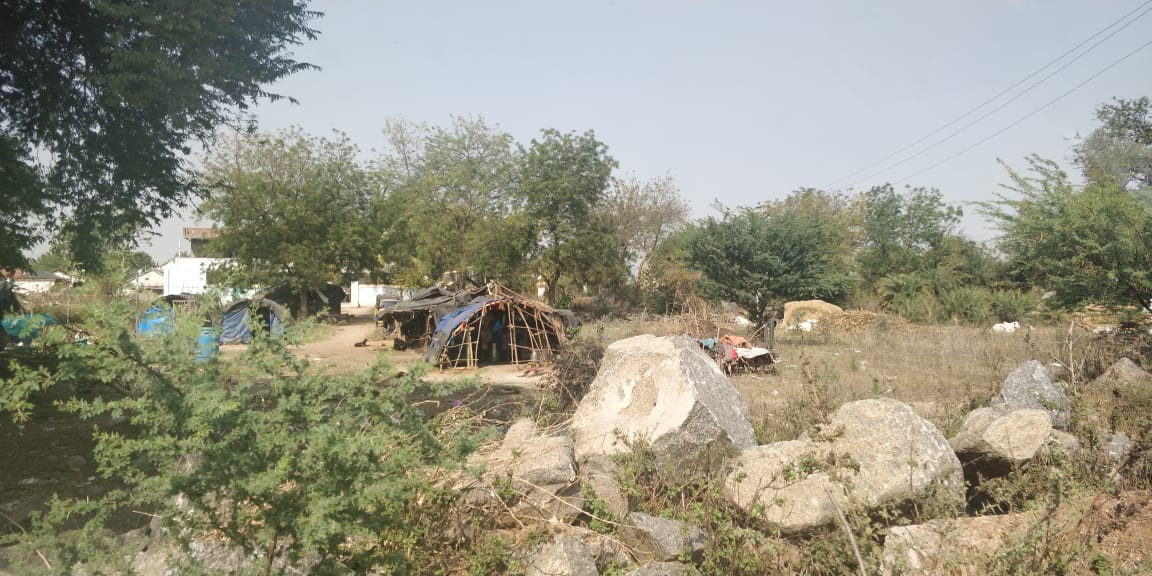
We crossed the Godavari river and took a left to the smaller roads. The scene changed rapidly from the average scene you see on a highway. The place looked as if it was so much deep in poverty.

Small road side scenes in Telangana
Its said that "Dams are the temples of the Modern India" and people who stayed just next to the temples were living in poverty. I am also from a village and I had seen huts like this during my childhood days. I was in the opinion that huts and gone for good these days. It felt like these people are left behind in the economical growth by at least 10 years.

We were welcomed by buffalos.
We were welcomed by buffalos blocking our way. We had to wait till they clear the way to go ahead. Following Google maps, we reached a spot which was marked as View point to find nothing there.

The place marked as view point on Google Maps

We stopped the car and walked up the bund.

We stopped our car there and walked up the bund to witness the Dam. The dam was huge. Might be the biggest dam I have ever seen. I was expecting an empty dam, but was shocked to see water in it. I used to thing my village is poor because, we do not have enough water to do agriculture. But might be I was wrong. Even with enough water, agriculture is not going to increase the living standards of people.


It just makes me think, might be what Arundhati Roy says in Walking with Comrades about Dams is true.
There was a time when believing that Big Dams were the ‘temples of Modern India’ was misguided, but perhaps understandable. But today, after all that has happened, and when we know all that we do, it has to be said that Big Dams are a crime against humanity.

Saturday, February 9, 2019

Avani

Avani is a small village near Kolar. This temple is located on a small hillock and has a beautiful myth surrounding it as in most of the other Temples of India.